
 Asosyoloji Dergi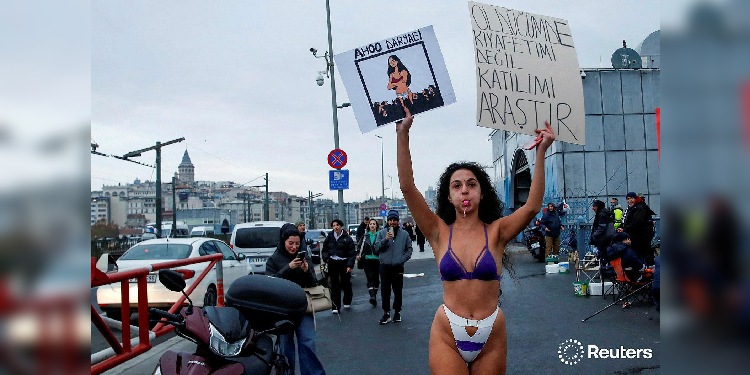
- We’dlike to go back to the very moment you first took to the streets. What did you feel in that moment, with all those eyes on you? What thoughts crossed your mind? Also, what motivated you before you began the protest where you expressed your resistance in the public sphere?
I started my protests in 2023. I’ve been holding demonstrations in the streets and public spaces for three years now. People’s reactions are usually one of shock at first, quickly turning into judgmental stares. In that moment, I always think, “Yes, I’m doing something powerful right now; I’m trying to express an idea, and I’m doing it by marching against the majority.”
I feel I need to stand up straight, and in that moment, I truly feel “brave.” Before I started taking action in public spaces, there was an incident when I was 15—I was sexually harassed by a teacher. He used the excuse that my skirt was “too short” and forced me to lift my skirt in front of a group of male students.
I specify “a bunch of male” students because he deliberately pulled me into their midst and demanded I lift my skirt there. That moment was the first time I confronted the thought, “Yes, I am a woman, and that is exactly why they want me to feel ashamed of my body.” Later, as I saw women in my own country restricting their clothing even when going out “so as not to be harassed,” I thought, yes, someone in this country must take such an action. That’s why I started protesting in a bikini, and doing so holds political significance for me. You’re shoving what bothers society right into their faces to convey an idea—and you’re doing it with a banner. “I am here,” you say
2- What was the moment of emergence for your political actions—those that transform the relationship with space and the public sphere through your body, suspend the daily flow, and create a rupture there? In response to which gaps, which silences, or which rendered-invisible experiences did they take shape?
People on the street are initially shocked when I start walking outside in a bikini. I find that look of surprise and questioning on their faces valuable because they’ll likely be questioning it even after they go home. I think it’s valuable to prompt people to think in the context we’re living in. Since my profession is modeling, I was already walking like I was on a catwalk outside, not just on the runway. But there were many turning points regarding this during my university years. Because my style of dress and the way I walked seemed “different” to them, I faced bullying in the early semesters. I didn’t care. When I didn’t care, the intensity of the harassment increased a bit. Some people were deliberately creating fake escort accounts in my name and collecting money from people. Of course, I don’t know if the people doing this were from the university. Their identities couldn’t be traced, after all. At the time, I filed numerous complaints with the authorities regarding this. As they passed by me, they would engage in slut-shaming by calling me things like “escort” or “whore.” Our society subjects you to a double standard when it sees a woman dressing as she pleases. If you dress like this, you’re either an “escort” or “crazy.” You can’t possibly be dressing this way by your own choice. You have to be something. Either an “escort” or “crazy.”
3- There are no slogans in your protests; Melisa Aydınalp stands before us with the sound of a whistle and her bold stride. Especially since you carry out your protests on the streets—sometimes alone, sometimes with just one other person. What is the purpose of this political atmosphere—slogan-free yet noise-making—that your choices create?
One of the reasons I act alone is that I don’t want people to have to wait for 100 others to gather and organize just to take action or express their views. That’s why I try to convey the idea to people that you don’t need to wait for 100 people to take action or express your opinion—you can do it on your own. In my own actions, I carry out the protest by wearing a bikini, holding a banner, and walking while blowing a whistle. The moment we step into the protest area, I start by blowing a whistle to gather people’s attention and draw all focus there. After the whistle, people immediately notice what I’m wearing, and then they try to focus on the sign. That’s why I think it’s effective. The action also aims to disrupt the system, after all.
4- This year, hate politics were fueled under the guise of the “Year of the Family.” Women, LGBT+ individuals, and animals—especially trans people—were subjected to a great deal of violence. We also see that you continue your struggle for trans people, women, and animals who were killed. How did you experience this year? Which pressures and policies were more visible from your perspective?
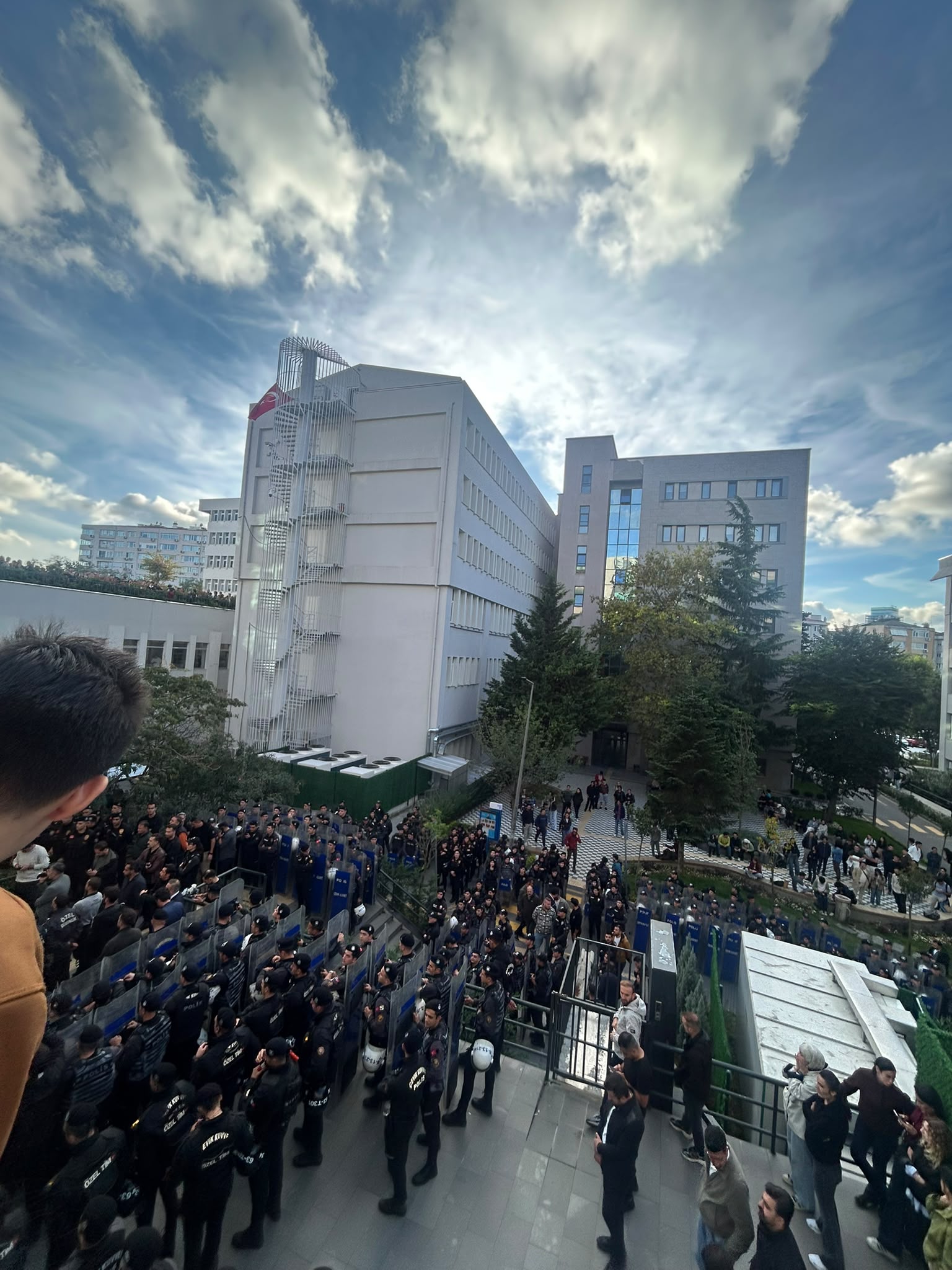
There are many moments when I’ve carried out my own actions alongside my trans friends. During the action I organized on Galata Bridge, the person holding the second banner next to me was a trans friend. In my view, trans people and women are sustaining many struggles together through solidarity in the same space. I find this incredibly valuable. I’ve observed that the pressure on us has intensified significantly this year due to the declaration of the “Year of the Family.” From debates about how we should give birth, to male soccer players entering the field with a “Natural Birth Is Normal” banner, to the so-called “reasonable” discussions about women, the violence directed at the LGBT+ community, and the penalties targeting “existence” proposed in the 11th Judicial Package… I can say this year has been marked by bans. In fact, in June, my home was raided by the Security Branch and I was detained for participating in a protest against the “Natural Childbirth Is Normal” policy. Subsequently, judicial control measures were imposed on me, requiring me to sign in at the police station for one month, and I was subject to a travel ban. Later, a decision of non-prosecution was issued regarding this case.
5-The cases filed against you and the interventions made generally revolve around “immoral acts” and “obscenity.” How does the concept of “modesty,” which is so sharply divided along gender lines, take on meaning in your march? We recall an action you took here where you marched against the “obscenity stick.” We want to discuss the aspect of your resistance against morality and obscenity that bends and challenges the normative. Beyond your marches, what can be done to talk more about these situations and expand the struggle?
I am someone who dresses in a feminine style in my own life as well. There is no law or ban regarding clothing in our country. The crime of “Indecent Acts” consists solely of elements such as exposing your genitalia or revealing them to someone in public. Wearing a bikini or similar clothing does not constitute this crime. Consequently, I have never been penalized to date. The cases filed against me either result in dismissal or I win the case.
After winning the case, I file a lawsuit against the state for both material and moral damages. In my opinion, they generally file these lawsuits just to wear you down and waste your time. It’s a form of harassment, essentially. In my own actions, I use a lot of banners and signs as a rebellion against toxic moralism (I’m referring to that segment of society that judges people and belittles you by pretending to be moral). Additionally, I believe that to change this understanding of toxic moralism, much more activism and performance art needs to be practiced in real life—in everyday situations. Because people don’t forget what they see firsthand.
6 What would you like to say to women and the LGBT+ community as we approach March 8th this year?
Every day we wake up to news of one of us dying. Each of us checks on a loved one every day, wondering if something happened to them or if they’ve died. Unfortunately, this has become our daily reality. We do this without question, automatically. We’re trying to survive. Because this is what the system has left us as a “gift.” All of this leaves us with severe stress and trauma. This is an undeniable reality. What I want to say to the LGBT+ community and women is this: No matter where we are or how far apart we may be—even if we’ve never met—our pain is shared. For this reason, I hope that this year we’ll join our voices together, both in the streets and in the spaces of action, and enter a year where our resistance grows even stronger.
7- Finally, we’d like to talk about your dreams and hopes. What kind of future does Melisa Aydınalp envision? What do you hope for regarding the future and your identity as an activist?
I will continue my activism. It has already become my way of life. I want to take my activism not only within Turkey but also abroad. I want to voice the issues faced by women living in this country even while abroad. I think it’s important for people to be aware of this. At the same time, I want the unlawful detentions that prevent me from living my daily life to end. I’ll conclude by saying, “Long live International Women’s Solidarity.”
Thank you so much for agreeing to this interview with us. We’re so glad you’re here 💜🌈

 Zeynep Altıok